
You're loading out at 1am, and the guy who books the venue is nowhere to be found. The bartender says he left an hour ago. Somebody on the crew says the pay's "already been handled," and nobody in your band remembers seeing a dime of it. You spend the next two days texting a number that doesn't answer, hoping this sorts itself out before the next show fills your calendar and you forget to keep pushing.
Most bar gigs don't need a contract lawyer, and most venues you play regularly aren't trying to stiff you. You're building a relationship with the same place that's paying you, so none of this is about distrust. It's about keeping the relationship solid even when somebody makes an honest mistake, a forgotten mention, a fuzzy memory, a bookkeeper who's slammed that week, and making sure everyone, you and the venue both, is working off the same agreement instead of four different memories of it. A handshake deal works fine nineteen times out of twenty. It's that twentieth time, when something doesn't line up, that you'll wish you had something to point back to.
Get it in writing before it's actually locked in
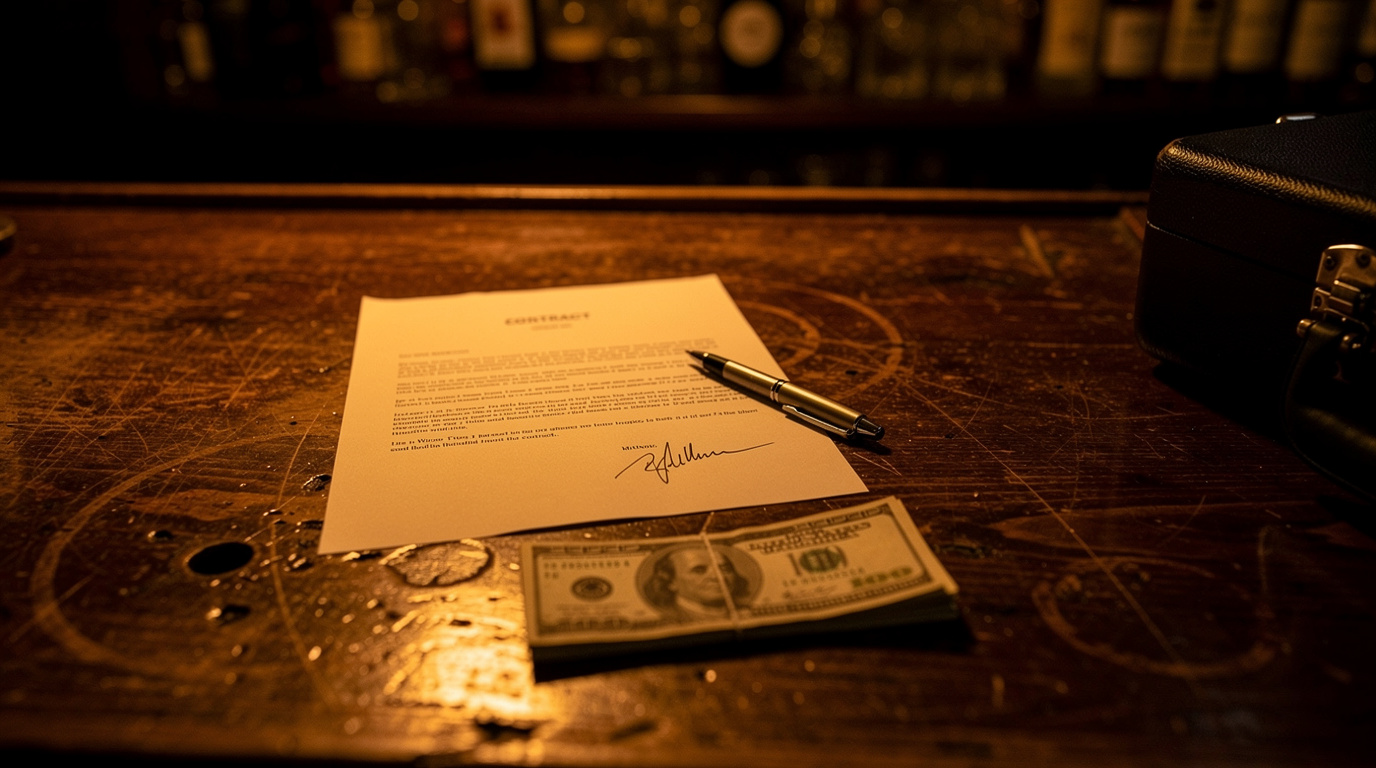
A phone call where a booker says "yeah, $800, come on down" feels like a done deal. Saying yes on that call is fine, it's what happens right after that actually locks it in. The real standard is a simple one-page contract, band name, venue, date, and pay, signed by both sides. It doesn't take a lawyer to put one together, and once you've built your own template, it's the same document every time with a few fields changed. A confirming text is better than nothing for the gig that came together fast, but it's a fallback, not the standard you want your band actually running on.
Whatever's on that contract, spell out exactly how the pay is calculated, not just the number. A flat guarantee is easy, it's the same figure no matter how the night goes. A door split or a percentage past a bar minimum needs the actual math written down, what percentage, what counts toward the minimum, who's counting the door at the end of the night. That's the detail that turns into an argument at 1am if it was ever just talked about instead of written down.
Worth putting in that same contract: what happens if the date falls apart. A cancellation or rain-out clause doesn't need to be complicated, just clear on what's refundable and on what timeline. A wedding canceled eight months out is a different situation than one canceled the week of, and an outdoor gig rained out an hour before downbeat is different still. You don't need a clause that lets you keep the deposit no matter what happens, that's not fair to a client dealing with a real emergency or a venue dealing with weather nobody controls. But you also shouldn't be the one eating months of blocked-off calendar time and rehearsal because someone changed their mind. Set the terms clearly going in, and there's nothing left to argue about after the fact.
Always ask for a deposit past a certain size
A $200 Tuesday solo bar gig doesn't need a deposit. A $5,000 wedding with a full band six months out does, because that's real money and various commitments riding on a date neither of you can easily undo. A deposit isn't just protection against the date falling through, either. It's you getting paid for the work that happens before you ever load in, rehearsing the material, blocking the date off from other paying work, coordinating four or five other people's calendars around it. That work is real whether the show happens or not, and a deposit is how you actually get compensated for it instead of quietly eating it for free. Twenty-five percent is a reasonable floor. Fifty percent isn't greedy, it's what a lot of working bands, ours included, ask for and get on most private events.
Know exactly who's supposed to pay you
At a bar gig, it's usually whoever's behind the bar at the end of the night. At a private event, it might be the client, or a planner, or an agent working on the client's behalf, and if you don't know which before the night starts, you're finding out the hard way at 1am. Get a name attached to the payment, not just a venue or an event. If money's flowing through a third party, ask directly: does the venue pay us, or do you, and when.
Write it down in your event notes, don't just carry it in your head, and get their contact info if you can, a phone number is worth a lot more than a name once you actually need to reach someone. One person in particular is worth nailing down ahead of time: your day-of-show contact, whoever's actually on-site and reachable the night of. That's often not the same person you originally booked the gig with, and it's the one number you'll actually need if something goes sideways at load-in.
Keep it in one place, not four people's memory
The version of this that actually breaks bands isn't a venue trying to shortchange you. It's one of your own bandmates getting paid directly by a promoter months ago and forgetting to mention it, because there was nowhere obvious to log it and no reason it'd come up until somebody's doing the math wrong at the next show. Whatever the deal is, who's paying, how much, whether a deposit already changed hands, needs to live somewhere every member can check, not just in whoever happened to take the call that day.
What to do when a venue goes quiet on payment
Follow up once, politely, within a few days, most delays are genuinely just a slow bookkeeping week. Follow up again a week later if nothing's moved, in writing this time, referencing the date and the amount you agreed on. Keep every message professional and keep emotion out of it, even when you're annoyed, a frustrated text can turn a slow payment into a damaged relationship, and you're still trying to protect a room you might play again. If it's been a month with no payment and no real explanation, that's the point to stop being patient about it and start treating it like the business problem it is, and to think hard about whether that room is worth playing again. This is exactly the moment professionalism matters most, not least. It's tempting to let a month of silence turn into a sharp email or a public complaint, but that's how a slow payment turns into a burned bridge and a bad reputation, over a problem that was never personal to begin with.
Where BandTopia comes in
Every deal term you agree to, guarantee, door split, who's responsible for paying, gets tracked right against that booking, not left to whoever remembers the phone call. The actual contract can live there too, uploaded straight to the booking instead of buried in an email thread somewhere. When a deposit comes in, log it as a payment received and label it as the deposit it is, so it's on the record the moment it hits, not something you're trying to recall three months later. Every call and text with a venue logs against the actual person you talked to, so "did we already get paid" has a real answer instead of a guess. BandTopia calculates every show's income and expenses automatically, and invoicing tracks exactly what's paid and what's still owed, so nothing quietly falls through because nobody was watching for it.
The deal was never really about distrust
Getting the number in writing, asking for a deposit, knowing exactly who's paying you, none of it is about assuming the worst of a venue. It's about making sure the good deal you already shook hands on is still the deal three weeks later, whether that's because a memory's fuzzy, a bookkeeper's slow, or somebody who used to handle this for your band isn't around anymore. Protect the number, and the relationship underneath it stays exactly as good as it was the night you agreed to it.
Ready to keep every deal term where the whole band can see it? Start free at bandtopia.io.